 Add to Chrome
 Add to Firefox
 Add to Edge
Resolving Representation Ambiguity in Feedforward Novel View Synthesis Transformer via Semantic-Spatial Decoupling
May 18, 2026
Transformer-based models have advanced feedforward novel view synthesis (NVS). Current architectures such as GS-LRM and LVSM mix semantic information (e.g., RGB) and spatial information (e.g., Plücker rays) into a shared feature space. Since Plücker rays naturally carry lattice-like spatial structure, these designs can make the spatial bias interfere with appearance representation and degrade rendering fidelity. To this end, we propose to decouple the representation of feedforward NVS transformers into separate semantic and spatial tokens. The decoupled design keeps semantic and spatial information explicit in their branches while preserving cross-branch interaction through shared attention routing. Built on this design, we introduce optional categorized supervision and bidirectional modulation: the former provides branch-specific training signals, while the latter improves interaction between the two branches. Notably, the base decoupled design introduces virtually zero additional inference latency due to its architectural design. The proposed designs achieve consistent improvements, demonstrating effectiveness across decoder-only and encoder-decoder feedforward NVS models.

GuidedVLA: Specifying Task-Relevant Factors via Plug-and-Play Action Attention Specialization
May 12, 2026Vision-Language-Action (VLA) models aim for general robot learning by aligning action as a modality within powerful Vision-Language Models (VLMs). Existing VLAs rely on end-to-end supervision to implicitly enable the action decoding process to learn task-relevant features. However, without explicit guidance, these models often overfit to spurious correlations, such as visual shortcuts or environmental noise, limiting their generalization. In this paper, we introduce GuidedVLA, a framework designed to manually guide the action generation to focus on task-relevant factors. Our core insight is to treat the action decoder not as a monolithic learner, but as an assembly of functional components. Individual attention heads are supervised by manually defined auxiliary signals to capture distinct factors. As an initial study, we instantiate this paradigm with three specialized heads: object grounding, spatial geometry, and temporal skill logic. Across simulation and real-robot experiments, GuidedVLA improves success rates in both in-domain and out-of-domain settings compared to strong VLA baselines. Finally, we show that the quality of these specialized factors correlates positively with task performance and that our mechanism yields decoupled, high-quality features. Our results suggest that explicitly guiding action-decoder learning is a promising direction for building more robust and general VLA models.
SWIFT: Prompt-Adaptive Memory for Efficient Interactive Long Video Generation
May 10, 2026Streaming long-video generation faces a central challenge in continuous semantic switching, requiring adaptive memory to preserve coherent visual evolution. Current approaches rely on cache rebuilding at prompt boundaries or fixed memory budgets, but they introduce redundant computation and limit flexible semantic adaptation. This limitation arises from a mismatch between cached video history and prompt updates, as memory preserves visual continuity while prompt switches demand rapid semantic adaptation. Motivated by this observation, we present SWIFT, Semantic Windowing and Injection for Flexible Transitions, a training-free framework for multi-prompt long-video generation that enables efficient semantic switching while preserving temporal coherence in causal video diffusion models. SWIFT introduces a lightweight Semantic Injection Cache that augments cached video memory rather than reconstructing it from scratch at every prompt boundary. To avoid uniformly perturbing all attention channels, we further perform head-wise semantic injection, so that each attention head receives a prompt update proportional to its alignment with the current video state. In addition, we introduce an Adaptive Dynamic Window that allocates temporal memory according to prompt phase, using larger local context near switching boundaries and smaller windows during stable segments to reduce average inference cost. To preserve long-range semantic consistency under compressed local attention, we further maintain segment-level semantic anchors that summarize prompt-conditioned video history and reintroduce it as compact memory tokens. Compared with current state-of-the-art methods, SWIFT preserves generation quality while achieving 22.6 FPS on a single H100 GPU, establishing a substantially more efficient solution for multi-prompt long-video generation. Our code is available at https://github.com/ShanwenTan/SWIFT.
Attention Itself Could Retrieve.RetrieveVGGT: Training-Free Long Context Streaming 3D Reconstruction via Query-Key Similarity Retrieval
May 10, 2026Visual Geometry Grounded Transformer (VGGT) advances 3D reconstruction via scalable Transformer architecture, but the quadratic complexity of global attention prevents long context application. StreamVGGT enables streaming with causal attention, yet its KV cache grows linearly with frames, causing memory overflow and quality degradation. We present RetrieveVGGT, a training-free framework, which formulates context construction for VGGT as a retrieval problem. By retrieving a fixed number of relevant frames at each step, VGGT maintains a controllable memory budget, which is close to its training context length. Interestingly, we find that the similarity between current frame queries and cached history frame keys at the first global attention layer of VGGT is already a strong indicator of relevance, eliminating the need for additional learned scoring. To enhance information diversity similar to a recommender system, we propose Segment Sampling so that the retrieval spans distinct relevant segments rather than a single high-similarity region. We design a pose-aware spatial memory mechanism that organizes history frames according to their already estimated camera poses, enabling location-aware retrieval. Extensive experiments demonstrate that RetrieveVGGT achieves state-of-the-art performance, outperforming StreamVGGT, TTT3R, and InfiniteVGGT while maintaining constant memory usage regardless of sequence length. Code is available at https://github.com/zzctmd/RetrieveVGGT.
Bench2Drive-VL: Benchmarks for Closed-Loop Autonomous Driving with Vision-Language Models
Apr 01, 2026With the rise of vision-language models (VLM), their application for autonomous driving (VLM4AD) has gained significant attention. Meanwhile, in autonomous driving, closed-loop evaluation has become widely recognized as a more reliable validation method than open-loop evaluation, as it can evaluate the performance of the model under cumulative errors and out-of-distribution inputs. However, existing VLM4AD benchmarks evaluate the model`s scene understanding ability under open-loop, i.e., via static question-answer (QA) dataset. This kind of evaluation fails to assess the VLMs performance under out-of-distribution states rarely appeared in the human collected datasets.To this end, we present Bench2Drive-VL, an extension of Bench2Drive that brings closed-loop evaluation to VLM-based driving, which introduces: (1) DriveCommenter, a closed-loop generator that automatically generates diverse, behavior-grounded question-answer pairs for all driving situations in CARLA,including severe off-route and off-road deviations previously unassessable in simulation. (2) A unified protocol and interface that allows modern VLMs to be directly plugged into the Bench2Drive closed-loop environment to compare with traditional agents. (3) A flexible reasoning and control framework, supporting multi-format visual inputs and configurable graph-based chain-of-thought execution. (4) A complete development ecosystem. Together, these components form a comprehensive closed-loop benchmark for VLM4AD. All codes and annotated datasets are open sourced.
Can Users Specify Driving Speed? Bench2Drive-Speed: Benchmark and Baselines for Desired-Speed Conditioned Autonomous Driving
Mar 26, 2026End-to-end autonomous driving (E2E-AD) has achieved remarkable progress. However, one practical and useful function has been long overlooked: users may wish to customize the desired speed of the policy or specify whether to allow the autonomous vehicle to overtake. To bridge this gap, we present Bench2Drive-Speed, a benchmark with metrics, dataset, and baselines for desired-speed conditioned autonomous driving. We introduce explicit inputs of users' desired target-speed and overtake/follow instructions to driving policy models. We design quantitative metrics, including Speed-Adherence Score and Overtake Score, to measure how faithfully policies follow user specifications, while remaining compatible with standard autonomous driving metrics. To enable training of speed-conditioned policies, one approach is to collect expert demonstrations that strictly follow speed requirements, an expensive and unscalable process in the real world. An alternative is to adapt existing regular driving data by treating the speed observed in future frames as the target speed for training. To investigate this, we construct CustomizedSpeedDataset, composed of 2,100 clips annotated with experts demonstrations, enabling systematic investigation of supervision strategies. Our experiments show that, under proper re-annotation, models trained on regular driving data perform comparably to on expert demonstrations, suggesting that speed supervision can be introduced without additional complex real-world data collection. Furthermore, we find that while target-speed following can be achieved without degrading regular driving performance, executing overtaking commands remains challenging due to the inherent difficulty of interactive behaviors. All code, datasets and baselines are available at https://github.com/Thinklab-SJTU/Bench2Drive-Speed
ACE-Brain-0: Spatial Intelligence as a Shared Scaffold for Universal Embodiments
Mar 03, 2026Universal embodied intelligence demands robust generalization across heterogeneous embodiments, such as autonomous driving, robotics, and unmanned aerial vehicles (UAVs). However, existing embodied brain in training a unified model over diverse embodiments frequently triggers long-tail data, gradient interference, and catastrophic forgetting, making it notoriously difficult to balance universal generalization with domain-specific proficiency. In this report, we introduce ACE-Brain-0, a generalist foundation brain that unifies spatial reasoning, autonomous driving, and embodied manipulation within a single multimodal large language model~(MLLM). Our key insight is that spatial intelligence serves as a universal scaffold across diverse physical embodiments: although vehicles, robots, and UAVs differ drastically in morphology, they share a common need for modeling 3D mental space, making spatial cognition a natural, domain-agnostic foundation for cross-embodiment transfer. Building on this insight, we propose the Scaffold-Specialize-Reconcile~(SSR) paradigm, which first establishes a shared spatial foundation, then cultivates domain-specialized experts, and finally harmonizes them through data-free model merging. Furthermore, we adopt Group Relative Policy Optimization~(GRPO) to strengthen the model's comprehensive capability. Extensive experiments demonstrate that ACE-Brain-0 achieves competitive and even state-of-the-art performance across 24 spatial and embodiment-related benchmarks.
PointAlign: Feature-Level Alignment Regularization for 3D Vision-Language Models
Feb 28, 2026The development of 3D Vision-Language Models (VLMs), crucial for applications in robotics, autonomous driving, and augmented reality, is severely constrained by the scarcity of paired 3D-text data. Existing methods rely solely on next-token prediction loss, using only language tokens for supervision. This results in inefficient utilization of limited 3D data and leads to a significant degradation and loss of valuable geometric information in intermediate representations. To address these limitations, we propose {\mname}, a novel feature-level alignment regularization method. {\mname} explicitly supervises intermediate point cloud tokens to preserve fine-grained 3D geometric-semantic information throughout the language modeling process. Specifically, we constrain the intermediate point cloud tokens within the LLM to align with visual input tokens via a consistency loss. By training only a lightweight alignment projector and LoRA adapters, {\mname} achieves explicit feature-level supervision with minimal computational overhead, effectively preventing geometric degradation. Extensive experiments on ModelNet40 and Objaverse datasets demonstrate that our method achieves \textbf{2.08} pp improvement on average for classification tasks, with a substantial \textbf{7.50} pp gain on the challenging open-vocabulary Objaverse classification task and \textbf{4.88} pp improvement on 3D object captioning evaluated by Qwen2-72B-Instruct, validating the effectiveness of {\mname}. Code is publicly available at \href{https://github.com/yharoldsu0627/PointAlign}{https://github.com/yharoldsu0627/PointAlign}.
Efficient-LVSM: Faster, Cheaper, and Better Large View Synthesis Model via Decoupled Co-Refinement Attention
Feb 06, 2026Feedforward models for novel view synthesis (NVS) have recently advanced by transformer-based methods like LVSM, using attention among all input and target views. In this work, we argue that its full self-attention design is suboptimal, suffering from quadratic complexity with respect to the number of input views and rigid parameter sharing among heterogeneous tokens. We propose Efficient-LVSM, a dual-stream architecture that avoids these issues with a decoupled co-refinement mechanism. It applies intra-view self-attention for input views and self-then-cross attention for target views, eliminating unnecessary computation. Efficient-LVSM achieves 29.86 dB PSNR on RealEstate10K with 2 input views, surpassing LVSM by 0.2 dB, with 2x faster training convergence and 4.4x faster inference speed. Efficient-LVSM achieves state-of-the-art performance on multiple benchmarks, exhibits strong zero-shot generalization to unseen view counts, and enables incremental inference with KV-cache, thanks to its decoupled designs.
Repulsor: Accelerating Generative Modeling with a Contrastive Memory Bank
Dec 13, 2025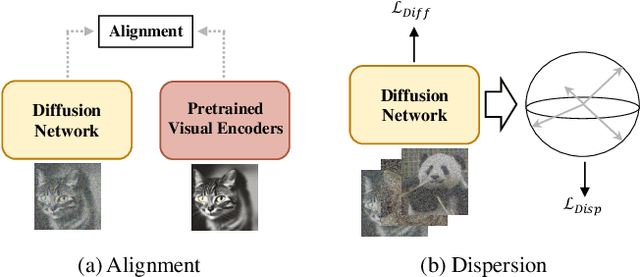
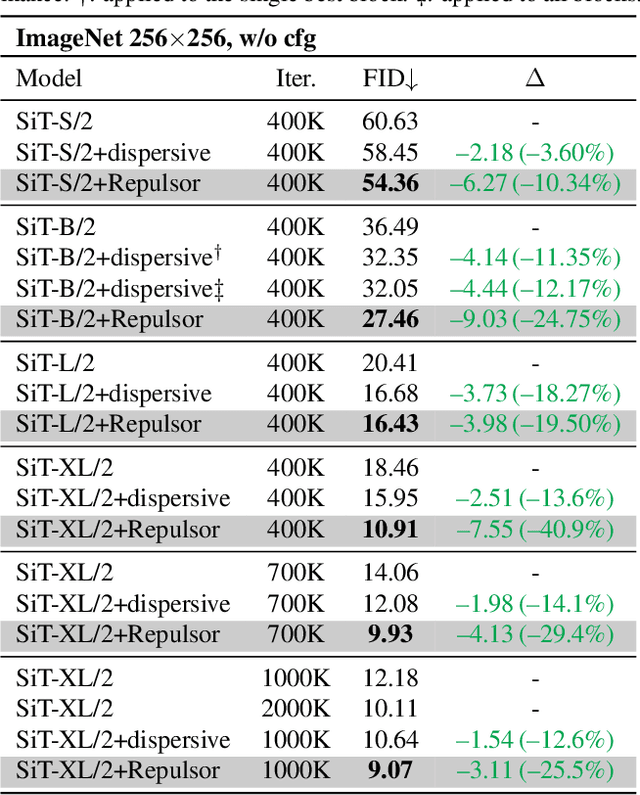
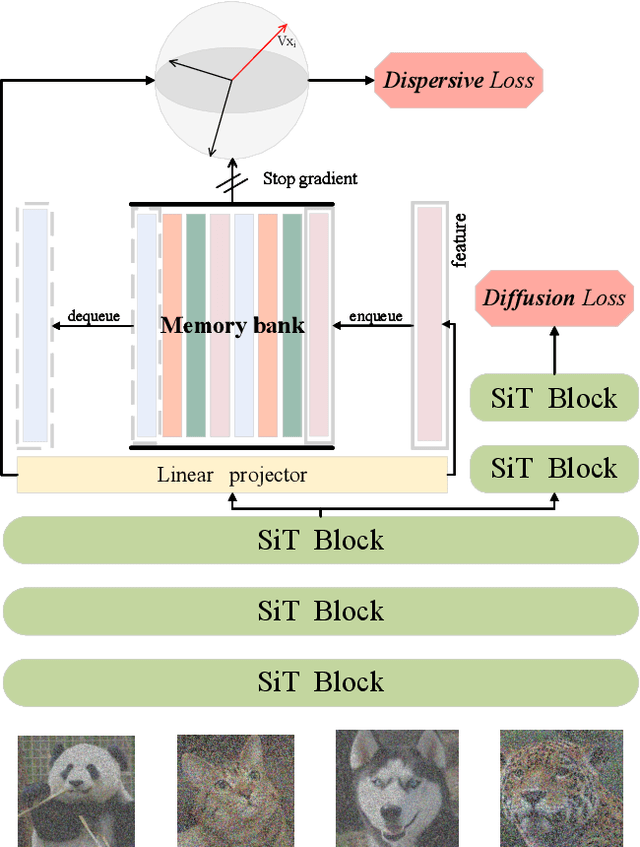
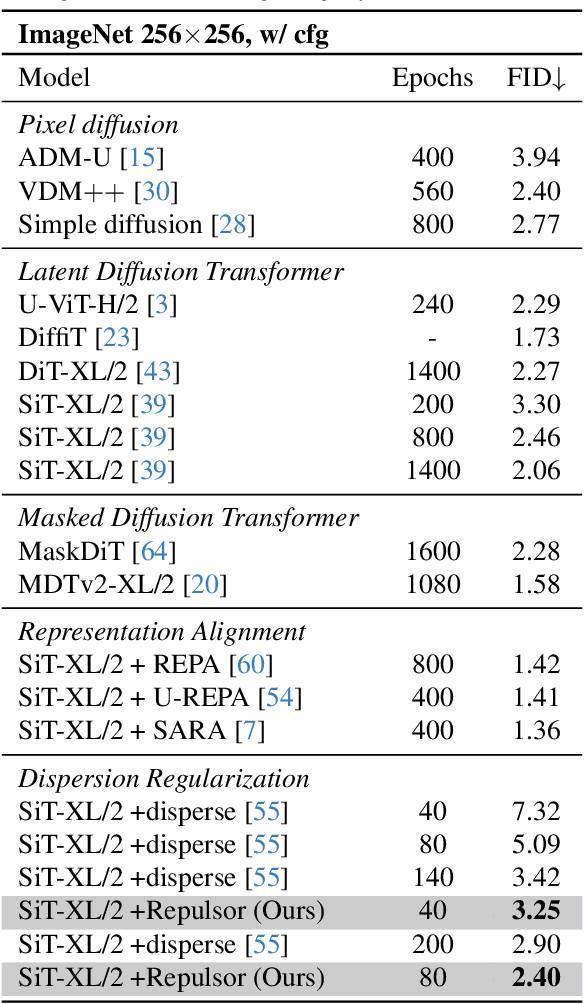
The dominance of denoising generative models (e.g., diffusion, flow-matching) in visual synthesis is tempered by their substantial training costs and inefficiencies in representation learning. While injecting discriminative representations via auxiliary alignment has proven effective, this approach still faces key limitations: the reliance on external, pre-trained encoders introduces overhead and domain shift. A dispersed-based strategy that encourages strong separation among in-batch latent representations alleviates this specific dependency. To assess the effect of the number of negative samples in generative modeling, we propose {\mname}, a plug-and-play training framework that requires no external encoders. Our method integrates a memory bank mechanism that maintains a large, dynamically updated queue of negative samples across training iterations. This decouples the number of negatives from the mini-batch size, providing abundant and high-quality negatives for a contrastive objective without a multiplicative increase in computational cost. A low-dimensional projection head is used to further minimize memory and bandwidth overhead. {\mname} offers three principal advantages: (1) it is self-contained, eliminating dependency on pretrained vision foundation models and their associated forward-pass overhead; (2) it introduces no additional parameters or computational cost during inference; and (3) it enables substantially faster convergence, achieving superior generative quality more efficiently. On ImageNet-256, {\mname} achieves a state-of-the-art FID of \textbf{2.40} within 400k steps, significantly outperforming comparable methods.